See what a new model does to your product before you switch.

Metergraph replays your production traces against the models and prompts you are considering, scores every answer against criteria you can read and edit, and shows where the change holds up.

See it in action

80% lower AI costs with better answers for one design partner. Half the optimization work for another.

Teams testing model changes with Metergraph

Start with a workload

Send traces with the SDK or bring them from the tools you already log to. Metergraph learns what your product does from the requests it has already answered.

How would each one affect your product?

A new model, a new prompt, a new setting, a new tool. Each can have unique repercussions on how users experience your products.

Fly them through your real traffic.

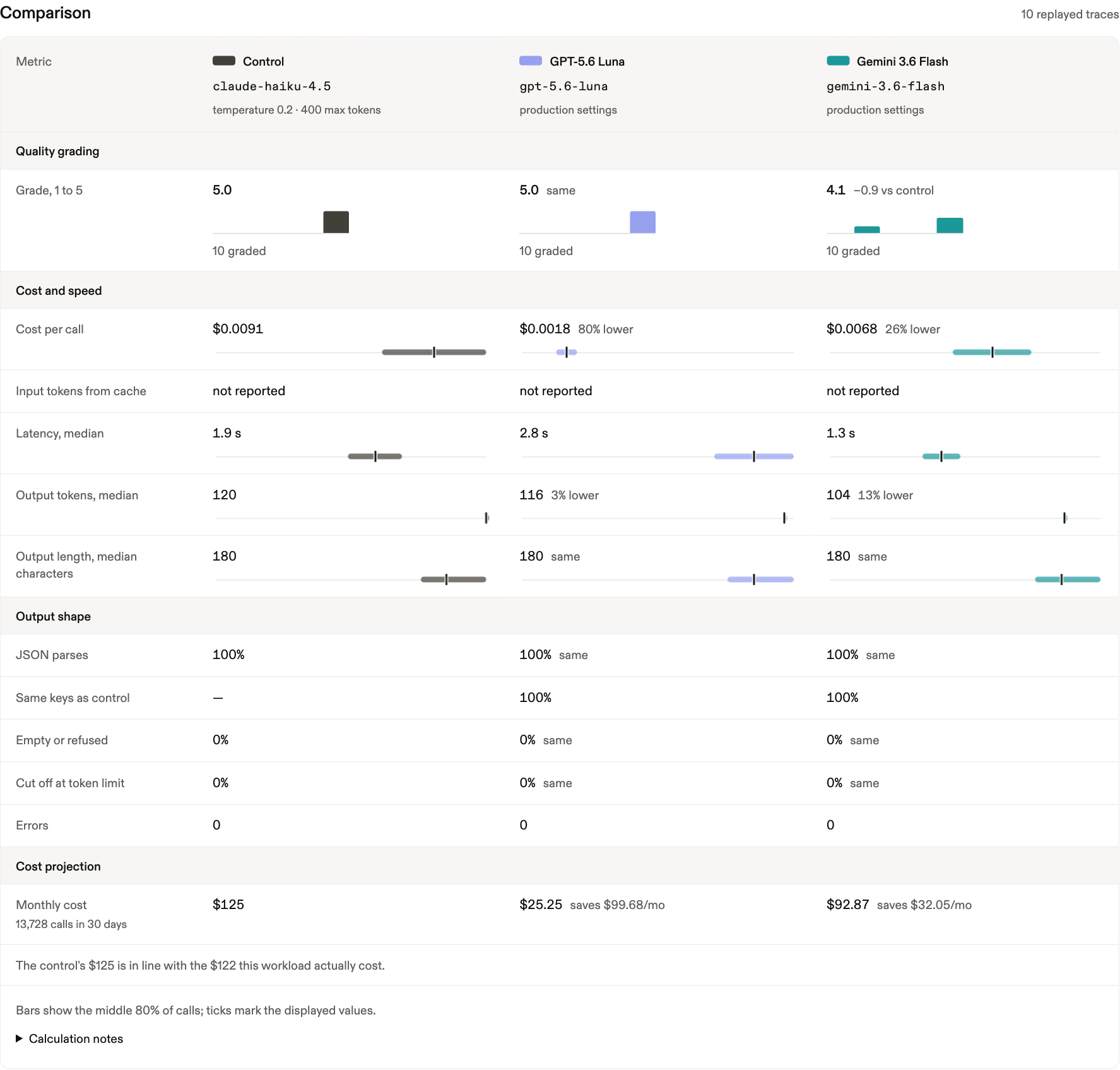
Metergraph compares selected candidates on eligible captured requests. Pulled from your historical traffic grouped by workload.

Experiment further.

Narrow your candidates to one choice by testing them on your evals and with custom experiments to search for the best hyperparameters.

Tighten a test. Run a new comparison.

In this illustration, a reviewer tightens a check and starts a new run in the app. One more experiment drops out, and one clears every hoop. Changing a check does not automatically rerun an analysis.

Know which change to make.

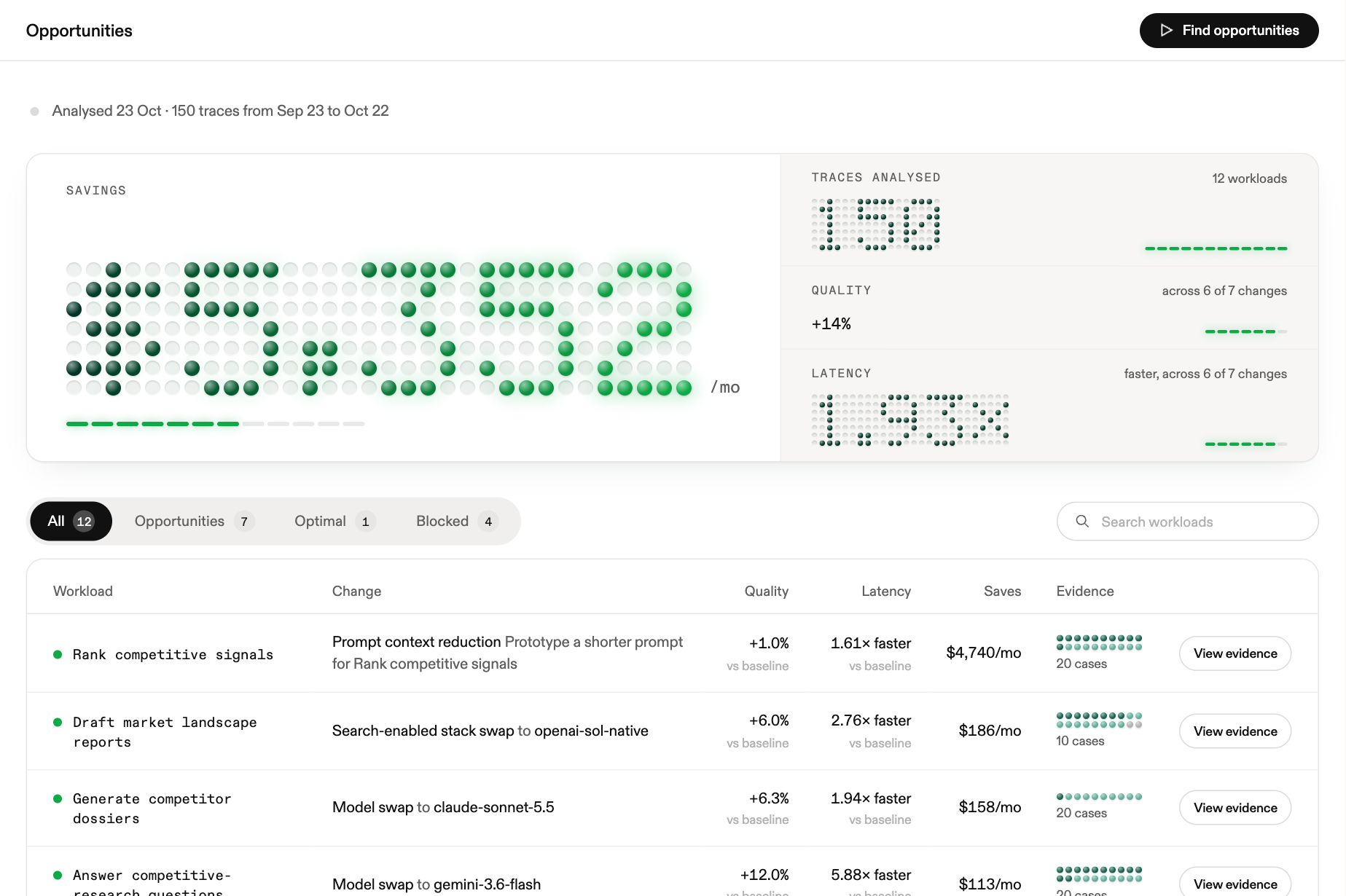
Sixteen possible changes went in. One made it through every eval on your own traffic.

  • ChangeNew model
  • ExperimentHigh reasoning
  • Evals clearedMetergraph built and your own5 of 5

Illustrative results, not a customer outcome. Review the evidence and validate changes in your application.

claude-sonnet-5gpt-5.6-lunagemini-3.8-flash Metergraph SDKOpenTelemetryLangfuseLangSmithBraintrustSelf-hosted CurrentNew modelSmaller modelNew providerFine-tuned modelNew promptFew-shot examplesOutput formatTrimmed contextTemperatureReasoning effortOutput lengthPrompt cachingNew toolsRetrievalRoutingFallback model Metergraph builtMetergraph builtYour evalMetergraph builtYour eval New model, high reasoningCleared 5 of 5 evals
New model, high reasoning5/5
New prompt, shortened intro5/5
Smaller model, few-shot examples3/5
Trimmed context, top 5 documents1/5
Reasoning effort, medium2/5
New tools, strict schema4/5
Routing, fallback on0/5

Illustrative results. Select a hoop to read its check.
Design partner results

Switch on evidence, not on the launch post.

Every change is tested on your production traffic first, so you see what it saves and how it affects answer quality before you approve it.

80% lower AI costs for a design partner, with better answers. A newer model from another provider cost far less and hallucinated less on their own traffic.
50% less engineering time on optimization for a partner who already tuned by hand, and 15% lower costs on top.

Ready to ship

Every recommendation arrives tested on your real requests and graded against what you ship today.

Checks you can read

Each eval is written out in plain language. Edit the ones Metergraph drafts, or add your own.

Numbers you can stand behind

Each result links to the requests, answers and grades behind it.

When it's time for Metergraph

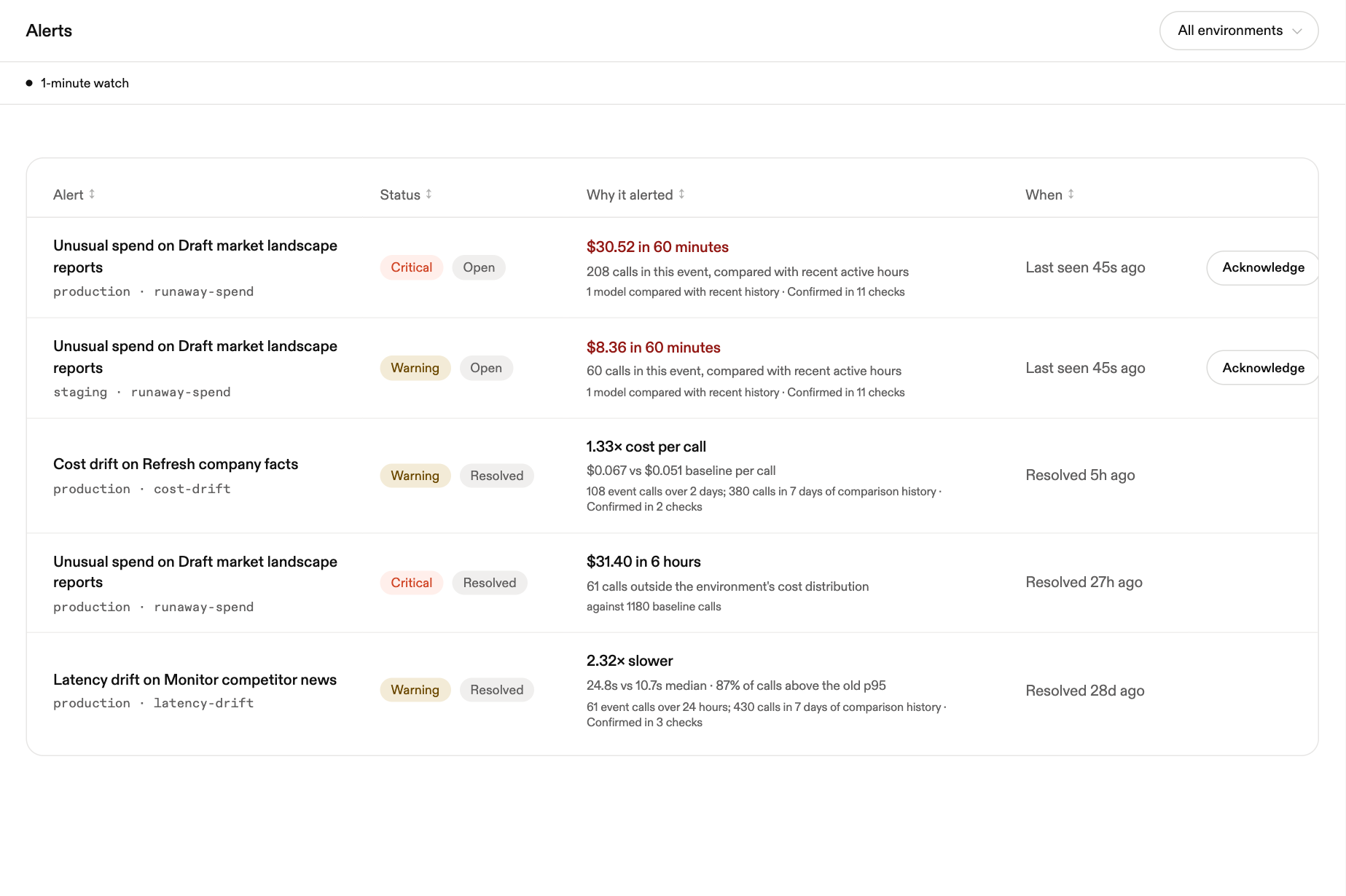
Something changed. Should you change too?

In the product

What you will see after you connect.

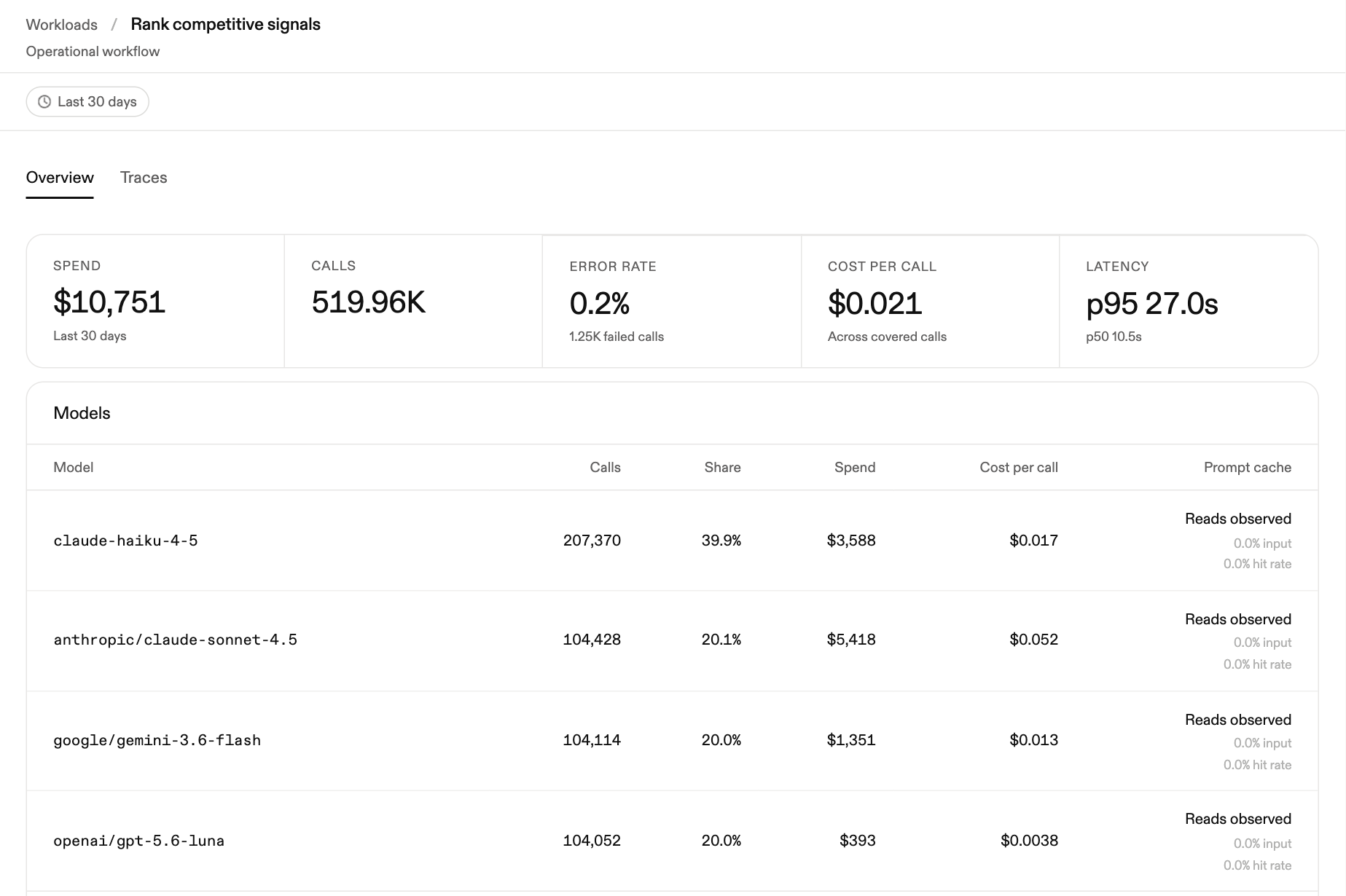
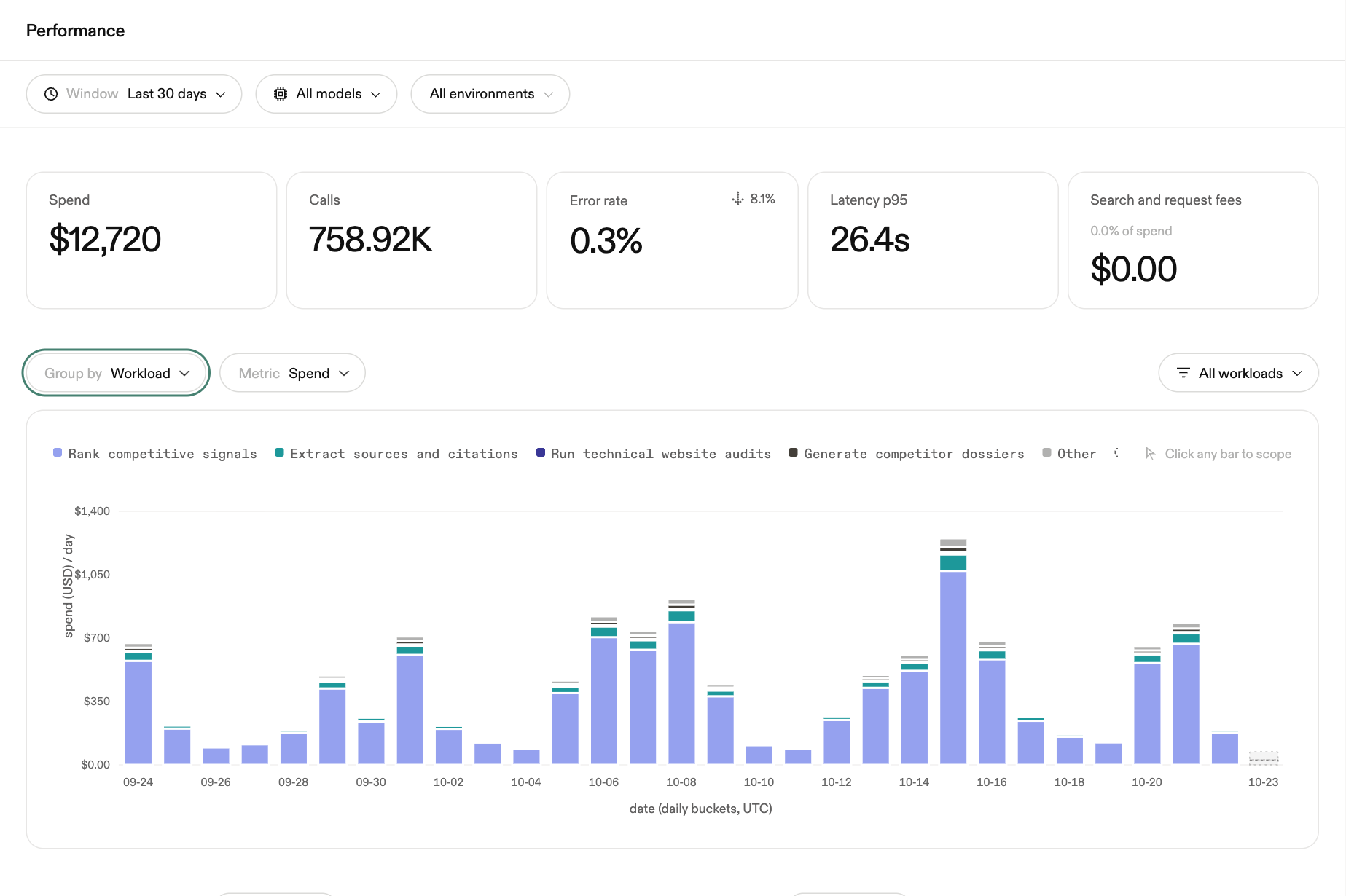
Cascade Marmot, an example company, spends about $12,700 a month on LLM calls. Here is where Metergraph takes them.

Performance groups spend by workflow. One workflow, Rank competitive signals, accounts for 85% of the $12,720 spent in the last 30 days.

Metergraph Performance page: spend, calls, error rate and p95 latency for 30 days, with daily spend grouped by workflow

For builders

Fits the way you already work.

Works with your coding agent

Metergraph finds and tests the change. Claude Code, Codex or Cursor makes it, and your team reviews the pull request. Install the skills →

Bring the traces you have

Wrap your client with the SDK, or import from Langfuse, LangSmith, Braintrust, Phoenix, Portkey or OpenAI with no code changes.

Free tools, no account

Price any LLM call with the Pricing API, run the open-source dashboard, or try the cost calculator.

Pricing

Free to start. More room as you grow.

Free

$0

50,000 calls and 3 completed experiment runs per month. A hard call cap keeps Free free.

Sign up free

Pro

$50 USD/month

150,000 calls with a hard cap and 10 completed experiment runs per month.

Choose Pro

Pay-as-you-go

2% of tracked spend

No monthly call or run cap. Includes all tracked spend, including experiments. Accrued daily and charged monthly.

Choose pay-as-you-go

MeterGraph funds up to $50 of experiment provider costs per workspace each month on all plans. Other experiment safety limits apply. Compare plans →

Frequently asked questions

What can I test?

Compare models, prompts and configuration changes on eligible requests. Inspect the answers and the checks used to score them.

Do I need captured request content?

Replay requires eligible captured content. You can use metadata-only capture to track usage and cost.

How do I connect my application?

Use the SDK or an existing trace source. See how to send your first trace.

Can I try it before sending my own traces?

Yes. Open the sample workspace to explore a preloaded dataset with no account.

Who writes the evals?

Metergraph drafts checks from your traces, written in plain language. You can edit them or add your own.

Does anything change in production automatically?

No. Metergraph recommends a change and shows the evidence. You decide, and your team ships it.

Try MeterGraph on sample data.

Explore MeterGraph with a sample dataset. No account needed. Prefer to talk it through? Book a call.